Analysis
Analysis of Results
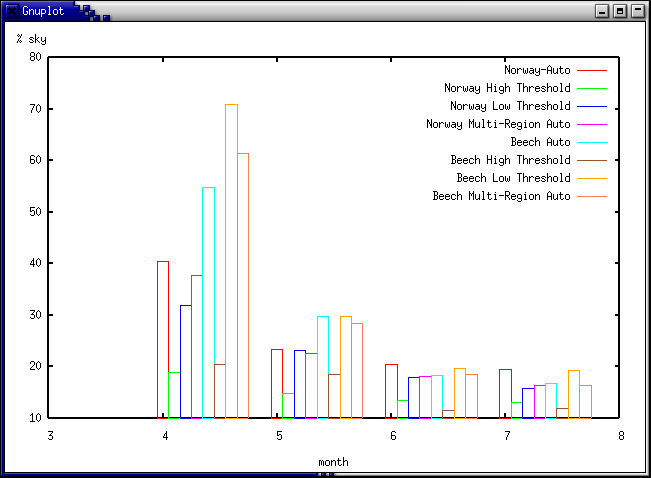
The resulting images from our thresholding program indicate that the hypothesis is partially correct: The Norway Maples do seem to initially block more light than the American Beech trees, although as the summer months wear on, they tend to even out and the difference becomes minimal. In fact, the Norway Maple seems to allow the same or even more light through by June.
As found earlier, the most intelligent thresholding choices seem to be made by the multi-region algorithm. Manually choosing thresholds can potentially generate the best values, of course-- this is true for nearly everything, so long as it is done well. Unfortunately, not all humans are equal in their ability to choose good thresholds for images based on histograms. This idea is enhanced by considering how our data compares with that obtained by some of the human lab researchers who originally worked on this project; our resulting images return rather different results for the %sky of each case. We are fairly certain that our methods are quite accurate after examining the original images and comparing them closely to our thresholded images. The images which showed the largest differences between the previously reported values definitely kept more miniscule areas of sky intact. This can be seen by taking one of our test cases, loading the images into xv or another slideshow program, and watching certain portions of the images to see how they change as each one goes past.
We did not fully explore some portions of this lab as we might have; notably, it would be interesting to see the results of increasing the number of regions we're using. We do not believe that increasing the number of circular regions would necessary improve matters, but perhaps cutting wedges out of the regions we are already created would improve matters for certain images.