Results and Discussion
Prepared by Caleb Shetland, Johanna Yoon, Kam Woods,
David Knouf, and Stefan Gary
Data were gathered from the analog input channels by the pendulum animation program for
each of three initial conditions on the voltages corresponding to pendulum displacement.
In all cases the initial velocities were zero. The data were plotted in Kaleidagraph
and are shown below.
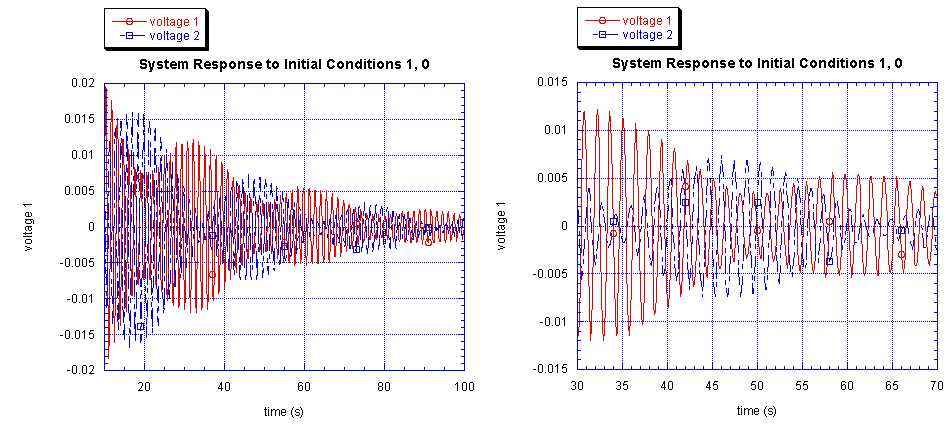
Initial Conditions 1, 0
It was shown in Experiment 3 that when one pendulum of a two-pendulum system is given an
initial displacement while the other is left initially at equilibrium, it is expected
that the amplitudes of the motion
of the two pendula will oscillate at a far lower frequency than that of the primary
oscillations. The amplitudes of the pendula will oppose each other as energy is transfered
to and fro, first one then the other reaching the greatest amplitude. Both amplitudes are
multiplied with a decaying exponential, damping the motion down to zero as time goes on.
The analog computer accurately reproduces this behavior. Data covering a ninety-second period
are shown here, revealing three maxima for each pendulum as well as significant damping.
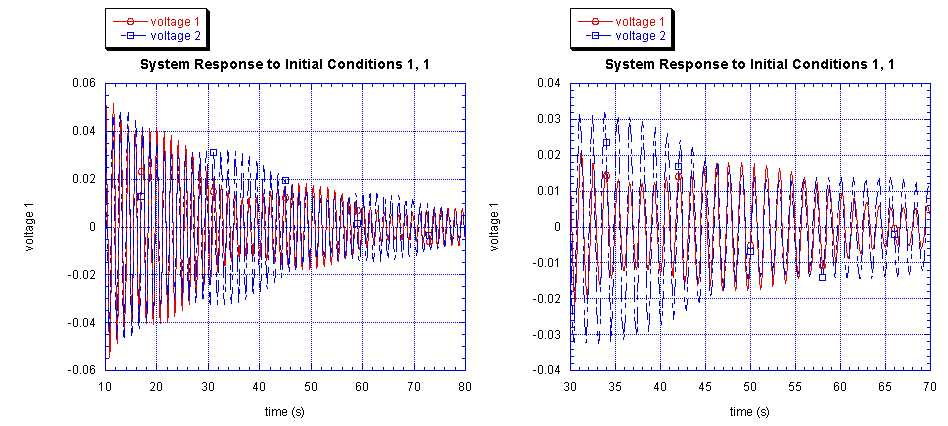
Initial Conditions 1, 1
From the results of Experiment 3 it is expected that two equal initial displacements for the
pendula will result in synchronous oscillations, the pendula in phase with equal amplitudes. Instead,
behavior is observed similar to that resulting from initial conditions of 1, 0. This is explained
by recalling that imprecise circuit element values correspond to unequal lengths and masses for the
two pendula. This means that, if the element values on each side of the circuit are different,
equal initial angular displacements for the two pendula do not indicate equal initial potential
energies. Such a situation can give rise to the back-and-forth energy transfer that typifies the
response to initial conditions of 1, 0. Note in the plot that the two voltages begin their oscillation
at the same amplitude before beginning to slip in to the more complex pattern.
Although the amplitudes of the oscillations of both pendulums vary with
time, the crests of both position outputs are syncronized. Therefore,
when one virtual pendulum is at a point of maximum angular displacement,
the other pendulum is also at its maximum and both pendulums swing in
the same direction. This matches the predicted behavior for the
system when the pendulums have equal and opposite initial conditions.
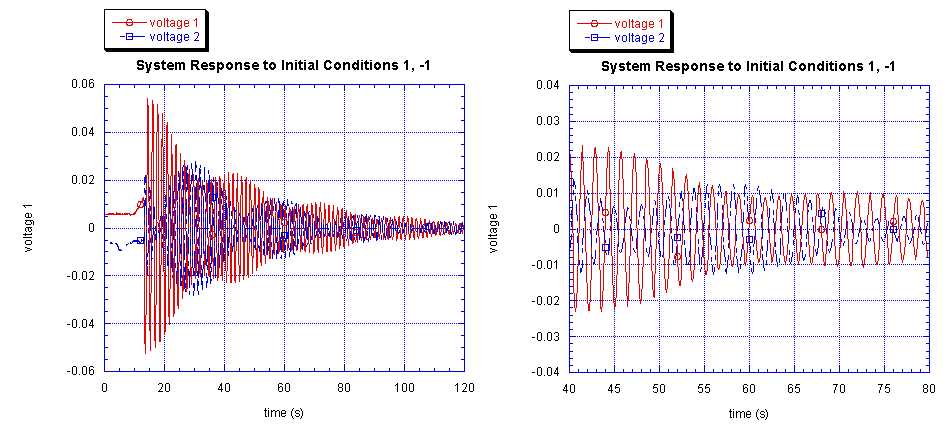
Initial Conditions 1, -1
Equal and opposite initial displacements are expected to yield an equal and opposite oscillation of
the two pendula, with amplitude unvarying except for the exponential decay. The varying amplitude
shown in the data is predicted by the same reasoning given above for initial conditions of 1, 1.
Also as above, the two pendula oscillate at the same frequency. In this case, however, the pendula
are half a cycle out of phase; that is, they reach their maxima simultaneously but swing in opposite
directions. This is as expected for these initial conditions.
Back to main page